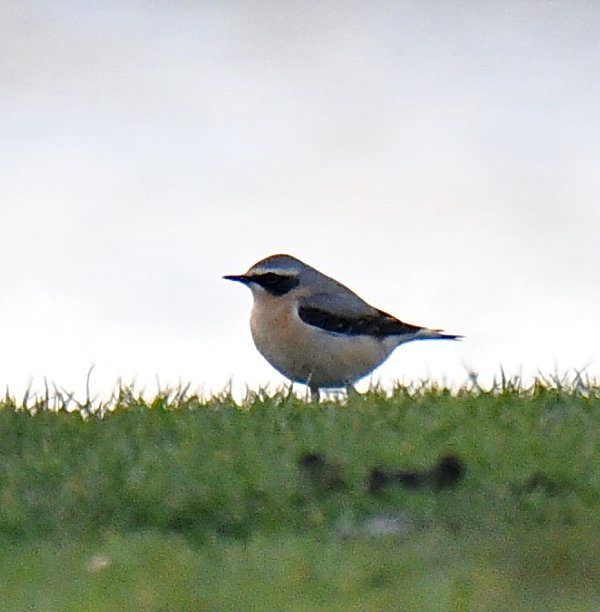
You can tell that things are picking up as I'm doing a new blog post so soon after the last one. In March we start to anticipate the arrival of the first spring migrants and as things are generally happening earlier each year, we might start to look out for things that would normally be arriving in April. Indeed we've already had our first spring migrants in the form of a total of three Wheatears. Two were found yesterday loosely following the river north on the Hinterland and then another single bird was seen today in the morning and was still present late afternoon before moving on.
The first Wheatear, courtesy of Matthew Lloyd
These are the first Wheatears in the county this year to my knowledge though we've already been beaten to the first Little Ringed Plover by Grimsbury Reservoir. It used to be the Meadow that got this species first most springs but the last few years Grimsbury has taken that award - indeed they've now had two of them already whilst we've yet to have our first.
We did get what was probably our first White Wagtail of the year today though the light was very bright and harsh and the birds were very distance so I wouldn't swear to it. This species normally turns up in April so it would be a very early record if it were one.
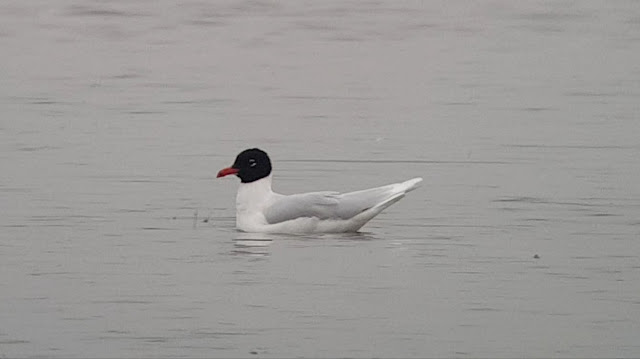
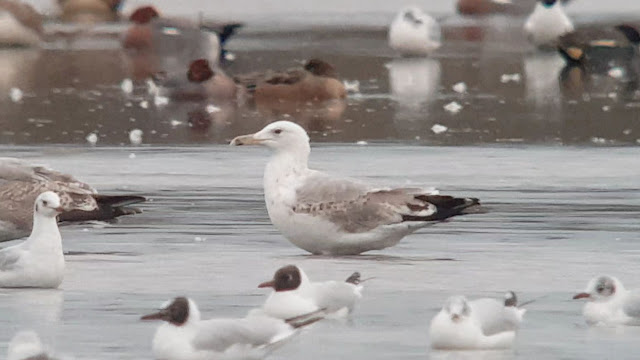
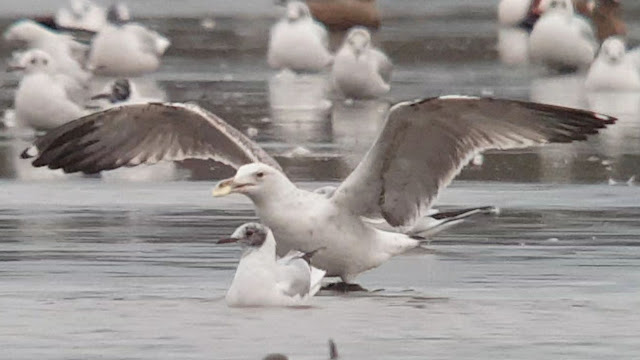
There was another Mediterranean Gull in the roost this evening: a fine 2nd summer bird. This is now the fifth Med Gull of the spring season already - a great total! Apart from that the gulling has been a bit quiet with just the regular appearance of a 2nd winter Yellow-legged Gull in the roost worthy of note.
The 2s Med Gull
On the wader front we've had the usual 2 or 3 Oystercatchers and 1 or 2 Redshank. We did have a flock of 4 Black-tailed Godwits on the 7th but they didn't linger. A pair of fly-through Curlew on Friday were a welcome year tick: this species normally is seen in February or not at all so I'm pleased to have it on the list.
On the duck front we've been getting up to half a dozen or so Pintail and Shelduck with the occasional Goosander as well. Number seem to be holding up at the moment but I guess will start to dwindle in due course.
On the passerine front the Siberian Chiffchaff proved to be a one day wonder. I've since been told that there have been no prior records of this subspecies on the Meadow so it's currently holding the bird of the year slot though it's early days of course. The 2 Brambling have been more obliging and have been hanging around in Burgess Field for a while now. There was also an intriguing report of a Black Redstart up in Wolvercote but it wasn't firmed up at all so I'm inclined to leave it off the year list.
Looking ahead, we should expect our first Sand Martins and Little Ringed Plover very soon now. My main concern now is the weather: with some fine settled conditions forecast for the rest of the month the floods will start shrinking far too early. Also good weather tends to mean that birds are more inclined to keep on with their migration rather than dropping in for a rest on the Meadow. We shall see!
Once again I've left it longer between posts than I would have liked and there is a fair bit to catch up on. As I've said previously, February is generally a fairly quiet month on the birding front but we haven't done too badly on the Meadow.
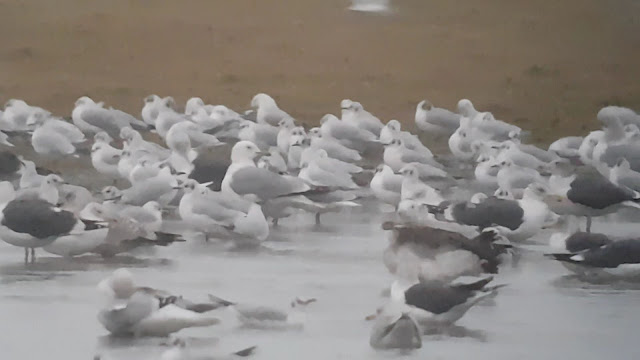
Starting with gulls, the roost is moving towards more of a spring feel to it with lots of Black-headed Gulls but far fewer larger gulls. Sifting through the smaller gulls we've had a great Mediterranean Gull passage so far with single adult birds on four occasions: 15th, 21st, 26th and 6th. Traditionally the Med Gull passage is more of a March phenomenon so it's a bit early this year. It's great to have had so many records already this year.
Med Gull courtesy of Thomas Miller
There have still been a few Yellow-legged Gulls around and a splendid 2w Caspian Gull was the star bird on the 3rd March.
Caspian Gull courtesy of Thomas Miller
On the wader front whilst it's still too early for spring passage waders there has been some definite movement on that front with Redshank numbers changing from the singleton that overwintered with us and up to 5 birds seen one day. A few Dunlin have also started to make an appearance with a peak count of 3 birds. There have been up to 3 Oystercatchers, they seem to be a pair and another single bird. A Black-tailed Godwit has been seen on a few occasions as well. The most unusual record is a couple of Ringed Plover on the floods one day: this is very early for this species which more usually passes through the Meadow in April.
Duck numbers are still good though we might start to see numbers diminishing over the coming weeks now as birds start to move on. We've had up to 11 Shelduck, a few Pintail, good counts of Shoveler (with over 70 seen on one day!) and a few Goosander coming into roost or being seen on the river. The first spring Gadwall are now also starting to appear.
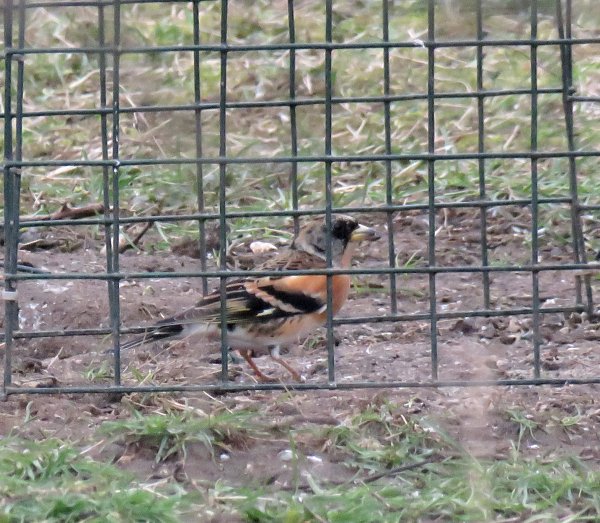
Away from the floods we've had up to two Brambling in Burgess Field which have hung around for a few days now. This is quite a rare species for the Meadow so it's great to have one stay so long so that people can get to see it.
The male Brambling in the feeder cage (for squirrel proofing)
Up at Wolvercote Lake a Little Grebe was heard there recently and a calling Cetti's Warbler (a nice year tick for a less than annual species) was heard one day. A Nuthatch is back at Medley farm after not being heard there for quite a while now.
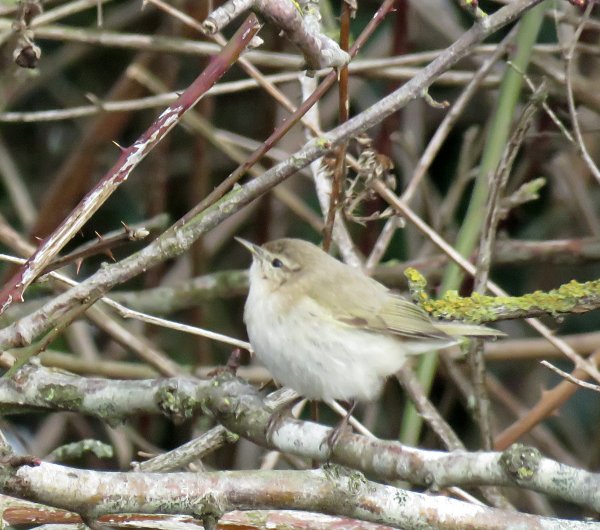
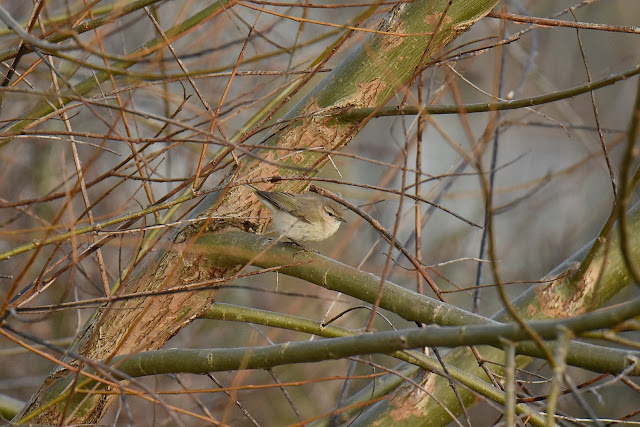
One of the star passerine records of the period was a putative Siberian Chiffchaff which was hanging around by Burgess Field gate this afternoon. This Siberian subspecies of Chiffchaff is quite distinctive looking, being a grey brown on the head and mantle with only a hint of colour in the wings and this one fit the bill perfectly. Strictly you need to hear them call to be 100% certain of the ID but it looked good to those who saw it.
Siberian Chiffchaff
...and again courtesy of Matthew Lloyd
So all in all, quite a lot of good birds over the last three weeks! Looking forward, over the next few weeks we should start to see Sand Martins appearing and maybe even the first Little Ringed Plover though both these things will very much depend on the weather and the current cold northerly wind won't help matters at all. As usual I am also fretting about the floods: a nice spell of wet weather would certainly help to top up the all important flood waters ready for the spring wader passage.
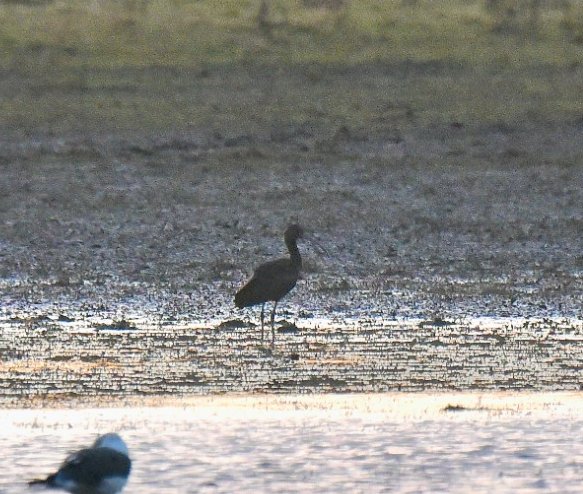
As I mentioned at the end of my last post, February is generally not that exciting so it's been a pleasant surprise to have some reasonable birds to report. The headline bird was the brief appearing of a Glossy Ibis at 5pm a few days ago. It was there for all of a minute or two before flying off and then relocating to Otmoor the next day. This species is fast going the way of Great White and Cattle Egret in colonising this country but it is still categorised as nationally Scarce on RBA so warrants inclusion on the hall of fame on the right-hand side bar of the blog. As a point of interest I am now no longer included the two Egret species on this list as they are more or less resident breeders in the county now.
Glossy Ibis, courtesy of Matthew Lloyd
Glossy Ibis, courtesy of Zhenhuan Zhang
The other point of interest was a smart adult Mediterranean Gull today in the evening's roost. There is usually a spring passage in March so this one is a bit early but then again everything is getting earlier these days. With this find, that marks the completion of all the gulls that we might reasonably find in a year on the Meadow. Sadly white-wingers are no longer in that category but still give us something to look out for as the winter gull season draws to a close.
Apart from that we've had the usual Yellow-legged Gulls and a few Caspians to keep us busy. "Novak" the tennis ball playing first winter Caspian put in another appearance recently and we had a smart adult in the roost a few days ago. Back in the day a Caspian find was something to get exciting about but they are now no longer the rarity that they used to be. This partly down to a marked increase in observer knowledge (thanks almost entirely to Thomas "the gull whisperer" Miller) and partly because they are genuinely getting more numerous in the county.
A smart adult Caspian, courtesy of Thomas Miller
On the wader front we've had one or two Redshank and the single Black-tailed Godwit hung around for a while though has now departed. We've had some huge Golden Plover flocks in excess of a thousand birds of late though it can be very hit and miss as to how many are present. There's not been much change in duck numbers so far though our Pintail have now disappeared. Shelduck numbers fluctuate but we had four on the floods a few days ago. There have been a few Goosander on the river though they've not been coming into the floods in the evening.
Looking ahead to the second half of the month, I guess that it will be more of the same. We will probably start to see some movement as over-wintering birds start to relocate but it will still be too early for any spring migrants. There is still the gull roost to sift through and in days gone by the end of the season was often when a relocating white winger would turn up though I don't know of any that are south of us in the country at the moment. The real jewel in the crown would be something like a Ring-billed Gull in the Common Gull passage. On a more realistic level we can hope for more Med Gulls and Caspians and we might get a spring Barn Owl in Burgess Field. Speaking personally, my thoughts are very much turning to spring now - I've had enough of this winter!
As usual I haven't done a post on the blog here until at least the end of January. As I said in my end of year review, January generally tends to be an exercise in reticking the same things as last year. Indeed I have a spreadsheet for the Meadow year list set up with all the species that I might expect to see in the winter months and, thanks to the team effort that is Port Meadow birding these days, we've managed to tick off most things on that list already.
Down to some details: as well as the usual winter ducks we've had a few Shelduck on the floods with up to 9 reported. A few Pintail have also been found in amongst the winter throng. As far as the geese are concerned, in amongst the now regular Barnacle Goose flock we've had at least one Red-breasted Goose with us all month though I'm not sure where it's partner went to. Egyptian Goose has also made it onto the list after their successful breeding last year.
Waders have been understandably thin on the ground though we've managed a Dunlin, a regular Redshank and a few Black-tailed Godwits. Sadly, gone are the days when we could expect a winter Ruff as a matter of course.
Winter is of course a classic time for gulling and we've had some reasonable large gull roosts this month to sift through. As well as a good number of Yellow-legged Gulls we've had at least three Caspians courtesy of our resident gull guru Thomas Miller. We've had no luck with Med Gulls so far though.
A fine 1st winter Caspian courtesy of Thomas Miller
In terms of other species that are harder to get, we've had Nuthatch and Little Grebe up at Wolvercote Laes as well as Tawny Owl heard by the canal. In fact the only things that I would reasonably expect on the year list which we've yet to have are Great Crested Grebe and Pheasant.
One of the more sad aspects of this month has been the large number of bird flu casualties. It's been a record breaking year for cases in the country and this has been reflected in the finding of moribund and dead geese and gulls (mostly Black-headed) on a daily basis.
A dead Barnacle Goose, courtesy of Zhenhuan Zhang
Looking ahead to February, there's not much to say really. It's generally a tough month for birding when all the usual species have already been ticked off and there are no spring migrants yet to look forward to. Still there is always gulling: we're long overdue a white winger but even finding a few more Caspians or a Med Gull will do.
As usual I am late with my end of year review. Still with not much happening in January apart from reticking the usual suspects it gives me time to reflect on the last year. In terms of the final year total it was another record breaking year. The previous record of 135 was created in 2020 and this year we have gone "at least" one better. I say "at least" because the final total depends very much on what birds you include on this list. To give an exact description of the state of affairs let me quote the figures as strict BOU + extras. So we have:
Key: r/s = release scheme f = feral but not BOU Cat. C pf = probably feral (though could be wild)
Exactly what to include on a list is the topic of many a long conversation in the pub. Personally I like to be fairly lenient on the ticking front and so my personal list includes multiple layers but that is another whole blog post in its own right. For now I'll leave it as above and will decide what listing authority the Meadow is going to use at some point down the line. Anyway, onto the round-up of the year.
Winter This started off with the usual fare. Fortunately there were plenty of gulls to keep the interest up and thanks largely to Thomas Miller's efforts we had plenty of Caspian Gulls, Mediterranean Gulls and a first winter Little Gull. The latter is rather unusual for the Meadow at this time of year with only one previous winter record during my time.
"Eric" the Casian Gull became a regular on the floods, courtesy of Thomas Miller
The unusual winter Little Gull courtesy of Thomas Miller
In March we had this lovely Med Gull
The tail end of winter brough us a couple of Brambling in Burgess Field. This smart finch is less than annual on the patch so it was nice to have a record on the year list.
Spring Spring was early this year. In March we not only had Sand Martins but a very early House Martin as well as Little Ringed Plovers and even a Ringed Plover. The latter we wouldn't normally expect until April. We also had a lovely flock of five Avocets that spent the day on the Meadow despite the efforts of a couple of photographers to flush them.
The highlight of March was a wonderful Black Redstart that was found up in Wolvercote. This was the first proper record for the patch, with previous birds consisting only of a boundary stretching one in Jericho a few years previously.
The Wolvercote Black Redstart courtesy of Matthew Lloyd
Also of note for March was a flurry of islandica Black-tailed Godwit records.
Islandica Black-tailed Godwitcourtesy of Thomas Miller
Things really stepped up a gear as we moved into April. Given that we don't usually have any flood waters in the autumn, this month marks the peak of passage movement on the Meadow of the year and is always an exciting month. We had an Osprey sighting and the Blenheim Little Gull dropped in for a few days on the Meadow.
Ospreycourtesy of Thomas Miller
Little Gullcourtesy of Thomas Miller
It was an excellent spring for Wagtails with very large daily counts of White Wagtails and quite a few Blue-headed and Channel Wagtails in among the Yellows.
Blue-headed Wagtailcourtesy of Thomas Miller
Some of the highlights of the spring were of "larger birds". We had a visit by a White Stork from the Knepp reintroduction project. It would occasionally be seen the Meadow but ended up spending much of its time over towards Wytham in the fields near the river.
The White Stork courtesy of Mario Garcia
One of the highlights of the spring was the appearance of three Glossy Ibis. This bird is following in the footsteps of Cattle and Great White Egrets in colonising this country though it's somewhat behind those species. So to have three of these smart birds around on the Meadow offering such good views was something special.
Two of the three Glossy Ibis
Towards the end of April we managed to get Whimbrel and Bar-tailed Godwit on the year list. Both these species are less than annual so it was good to have them there. As we moved into May things quietened down some more despite some unseasonal rain that kept the floods topped up. We added Grey Plover and Wood Sandpiper to the list as well before the spring passage ended.
Summer The summer months are traditionally slow on the bird front. We had the pair of Otmoor Cranes commuting over our air space to Chimney Meadows and the feral flock of Snow Geese dropped into the Meadow for a visit.
Commuting Cranescourtesy of Thomas Miller
The feral Snow Goose flock
In these quieter times other aspects of nature often become the focus of our attention. There was a lovely Downy Emerald dragonfly in the Trap Grounds for a few days. This is a comparatively uncommon species in Oxfordshire.
Down Emerald courtesy of Nicola Devine
There were also orchids to look at with lots of Bee Orchids and Pyramidal Orchids to be found thanks to optimal growing conditions for flowers. Indeed Burgess Field was a riot of colour this summer with far more species and growing far taller than usual.
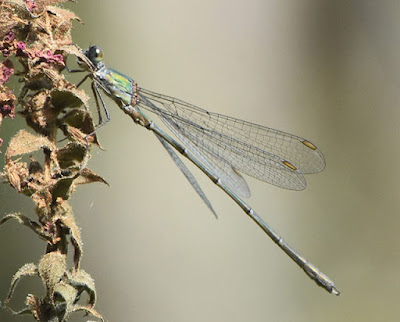
As we moved into autumn, our star odonata species from last year, Willow Emerald, was once again found in the Trap Grounds.
Willow Emerald
Autumn There was a slow start to Autumn with not much to report beyond a few Redstarts and Spotted Flycatchers. We did have a Great White Egret sightings when one flew down the river but there was little else. The Blenheim and then Otmoor Cattle Egrets eventually found their way to the Meadow and it was lovely to see them in amongst the cattle. They eventually moved on to the livestock fields in Wytham where they are spending the winter.
Cattle Egretscourtesy of Matthew Lloyd
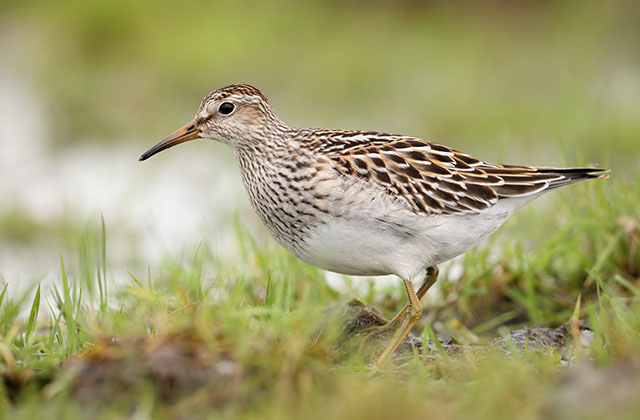
Things all stepped up a gear towards the end of October. The floods returned earlier than usual which meant that we had some small pools which ended up pulling in a Pectoral Sandpiper. This neartic wader has only been recorded twice before on the Meadow and was a proper national scarcity with many people coming from far and wide to see it. It ended up staying for about a week.
Pectoral Sandpiper courtesy of Stephen Burch
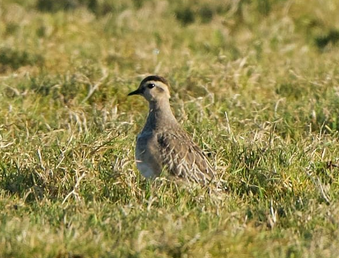
Winter Again November was predictably quiet and it looked like December was heading that way as well until a wonderful first winter Dotterel was found in amongst the Golden Plover flock. This species is rarer in the county than Pectoral Sandpiper and is certainly a first for the Meadow. It was seen sporadically over a week or two before relocating to Otmoor on the last day of the year.
Dotterel courtesy of Ollie Padget
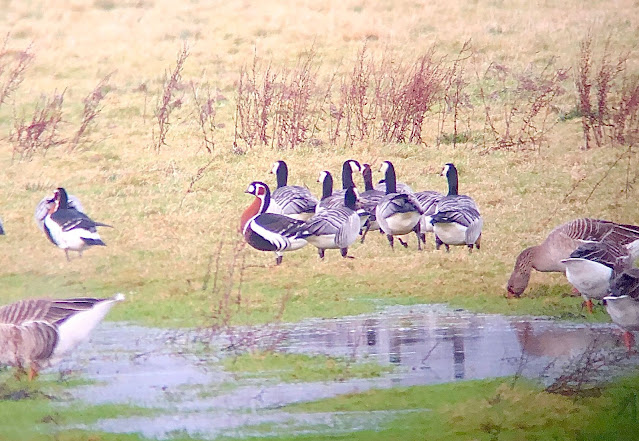
The only other birds of note were the two Otmoor Red-breasted Geese which relocated from Otmoor to join the Meadow Barnacle Goose flock. Whilst these are more likely to be escaped birds they make a colourful addition to the Meadow geese.
Red-breasted Geese courtesy of Joe Tobias
The Bird of the Year
So its finally time for the coveted bird of the year award. With another record breaking year and some great birds, the short list is pretty strong but in the end it has to go to the first winter Dotterel. It was the rarest county bird and a first for the Meadow. Let's hope that it pops in again sometime soon to grace the pages of the new year list.
There's not been anything of particular note for the rest of December to push me to doing another blog post and somehow things have drifted until the end of the year. The star Dotterel was belatedly reported once again on the 16th by a photographer and subsequently turned up at Otmoor so it's still very much around though not staying faithful to any one spot. The Golden Plover flock seems to have disappeared now so we're less likely to see it again on the Meadow for the time being.
The floods just about held together until finally we got a decent amount of rain which pushed them up to a larger size. We ideally need the river to flood at some point to ensure that they are nice and full for the spring passage. We finally started to get a bit of a gull roost towards the middle of the month with a few Yellow-legged Gulls and a 4w Caspian Gull (the latter courtesy of Thomas Miller). Towards the end of the year, the increased number of people on the Meadow meant that any roost was highly likely to be disturbed and the gulling was difficult.
The 4w Caspian Gull courtesy of Thomas Miller
Regarding water fowl, apart from the usual species there was a Pintail one day that Mary MacDougall reported. At the end of the month the Otmoor Red-breasted Geese decided to change location and started to hang out with the Barnacle Geese on the Meadow. They make a most colourful addition to the goose population on the Meadow even if they are in all probability escapes.
The Red-breasted Geese courtesy of Joe Tobias
In terms of waders, there was a female Ruff on a couple of occasions and a single Redshank was seen for a few days. Regarding other species, a heard-only Brambling flew over Wolvercote at dusk (per Nick Boyd) and a few Redpoll have been heard going over Burgess Field by Ollie Padget.
So that's the end of another birding year on the Meadow. My next post will the customary annual review but now it's time to scrub out the year list and start all over again!.
December had been rather quiet up until a few days ago. Indeed, when thinking about what to post for the next blog update the most exciting thing that I could think of was the fact that the winter gull roost had finally kicked off. We've had up to 500 large gulls at the evening roost though so far the best that has turned up has been a few Yellow-legged Gulls.
Apart from the gulls it's been the usal birds: a flock of several hundred Golden Plover, a dozen or so Lapwing, a few hundred Wigeon and a smaller number of Teal and good counts of Canada Geese and Greylags with a moderate flock of forty or so Barnacle Geese thrown in for good measure. Winter duck numbers have been steadily increasing throughout the month though we really need more rain to take things to the next level.
A few of us have been dutifully scouring through the various flocks each visit, with American vagrants the main object of our searches. So for the Wigeon it would be American Wigeon, for the Teal it would be Green-winged Teal and the Golden Plover have been searched for American Golden Plover. Of course it's a long shot for each of these but that is how these things are found. This diligent searching suddenly paid off big time this week when on Tuesday Ollie Padget turned up an overwinterting Dotterel in amongst the Golen Plover flock. Completely left field this it not something you'd expect to find at all at this time of year and indeed is the first ever record for the Meadow. The bird was found early afternoon and hung around until about 4pm when it flew off in a northerly direction.
Dotterel, courtesy of the finder, Ollie Padget
Once news was released this prompted a photograph from a less experienced birder who it turns out has seen it on Saturday in amongst the Goldies though didn't know what it was.
On Saturday, courtesy of Paul Torevell
The next morning it was seen again in the morning before a bastard photographer flushed it by trying to get too close. That was the last time that it was seen.
This bird nicely trumps the Pectoral Sandpiper in taking the Bird of the Year slot. Whilst nationally a Dotterel is a summer breeder whereas Pectoral Sandpiper is a scarce vagrant, in terms of Oxon records Dotterel has only been seen three times since 2001, far fewer than Pec Sand: a) May 2004, one day bird near White Horse Hill b) Apr-May 2012: long stayer near Balscote Quarry, Banbury area c) May 2016: single observer record near Barford St John
So a cracking new Meadow record and a wonderful bird to see.
To add icing to the cake, a non birder reported via Twitter a Whooper Swan on the river the previous weekend and even backed it up with a (rather blurry) photograph. So that is a second year tick and pushes the tally further ahead to a new record breaking total of 138 (including Snow Goose). Could we possibly squeeze one more tick out this year? It's not impossible!
So we're getting near to the end of November already and closing in on the end of the year. The floods are still about but looking rather stunted - we really need some decent rain to expand them so that the two pools join up. This would encourage some decent gulls to the roost which is currently still rather anaemic.
Despite the lack of water there have been some modest Wigeon and Teal around as well as a few Lapwing and an increasing flock of Golden Plover with numbers creeping up to four hundred or more. Still no sign of any vagrant plovers in amongst them but we'll keep looking! Geese numbers are reasonable though the Barnacle Geese haven't really been about much of late.
This pair of Egyptian Geese have been around on and off on the Meadow for a while now
With the lack of water, the main birding action has been in Burgess Field. Indeed we have managed to get two new year ticks from here. Firstly a Woodcock was seen in flight at dusk there and secondly a Barn Owl has been seen (again at dusk) on at least two occasions. The second time there were also a couple of calling Tawny Owls about as well.
Apart from that it's been the usual species with a few Siskins, winter thrushes etc that one would expect at this time of year. There have been a few over-wintering Chiffchaffs about recently.
This addition of two birds to the year list has left us tantalisingly matching last year's record year list count of 135. A concerted effort over the last few weeks of the year (or alternatively just some good luck!) could see us break this record. Indeed Nick Boyd came close today with a possible Hawfinch over the St Edward's area but he wasn't able to confirm it. Other good candidates to take us over the line would be Little Owl, Red-crested Pochard, Red-legged Partridge, Whooper or Bewicks Swan. Of course we could get an out and out rare. It's all to play for!
Despite the late floods this spring (which tends to kill things off) there is plenty of Creeping Marshwort around at the moment (if you know where to look). I took this photo when I noticed a clump right next to my tripod when the Pectoral Sandpiper was first found.
Our star Pectoral Sandpiper ended up staying for exactly a week. It was nice to go down to the Meadow each day and to find it still picking its way along the shoreline. It remained faithful to its small pool for the entire time apart from on one occasion when a dog must have scared it as it moved away into the grass. Various out of county birders came to pay homage though numbers were never that large and everyone was well behaved.
The Pectoral Sandpiper courtesy of Steve Burch
The flood levels have held their own but we haven't really had enough rain to increase them in size so far and they are still a bit too small to hold any large counts of birds. Still, the winter duck numbers are starting to increase and this morning there were probably about 100 Wigeon there along with a smattering of Teal. There has been a noticeable increase in Canada Geese numbers with the flock now numbering serveral hundred though I haven't seen the Barnacle Geese for a few days now.
There has been noticeably large counts of Pied Wagtails on the floods in the evening. I think that lots of them come to the Meadow before heading off to roost in the city somehwere. Golden Plover numbers have increased noticeably with several hundred to be found hunkered down on the grass between the two pools most days along with a dozen or so Lapwing. It's the time of year for searching through them carefully for one of their American cousins though no luck so far.
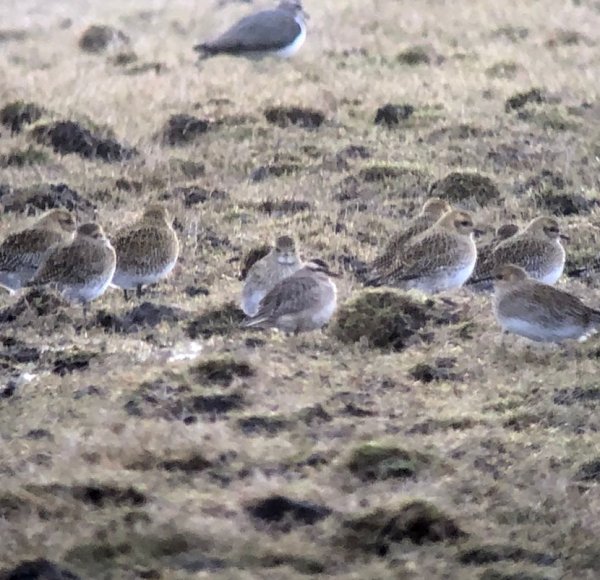
Golden Plover courtesy of Steve Liptrot
One of the highlights since my last post was a Little Grebe that was seen up at Wolvercote Lake by Nick Boyd - a Patch year tick no less! A red-headed Goosander was seen on the river and then on the Castle Mill stream recently. Ollie Padget had a Great White Egret on the floods briefly though there is not enough cover there really and it didn't linger.
The Great White Egret courtesy of Ollie Padget
This morning Ollie and Thomas Miller saw a Brambling (another year tick!) in Burgess Field though sadly it didn't linger. Winter thrushes have started to appear in numbers in Burgess Field with lots of Redwing about and one flock of Fieldfare as well this morning. Siskin are often to be seen flying over and there have been one or two Redpoll as well.
With all these winter birds, the change of the clocks and the nights drawing in, there is no doubting the change of the season. It's very much back to winter birding now.
I had rather been casting around for something to write about over the last few weeks. Fortunately it's all kicked off and I now have more than enough to report! It all started on Sunday 17th when Thomas Miller found a Jack Snipe around the verges of what were then little more than muddy puddles where the floods normally are. This species is now less than annual on the patch. They used to be fairly regular up in the pools in the Snipe Field in Burgess Field. However, as that field has got more overgrown the pools have disappeared and the Snipe and occasional Jack Snipe have gone with them. So this was a most welcome year tick for the Patch.
Last week we finally had enough rain to restart the floods and with it birds started coming back. The now regular Barnacle Goose flock has been joining the Canada and Greylags on the Meadow. With up to 100 Golden Plover, a handful of Lapwing and a few early Wigeon and Teal and even a red-head Goosander on the river, it was starting to feel like winter already!
However, the best was yet to come when on Saturday morning Thomas Miller, who was leading a group of student birders on a tour around Port Meadow, managed to find a Pectoral Sandpiper feeding away on the southern flood pool (the two halves are still split at the moment). This is a nationally scarce American vagrant which somehow had managed to survive the Atlantic crossing and found it's way to Oxfordshire. Whilst it is the commonest of the American vagrant waders it is still quite a rare vagrant to the county and it's only the third record on the Meadow. The first was a pair that lingered for some while in 2007 whilst the second was a one day singleton in 2011 so it has been 10 years since our last one. This discovery prompted a proper Meadow twitch as all the Meadow regulars as well as lots of county birders descended to pay their respects.
A fantastic photo courtesy of Steve Burch
Video courtesy of Badger
The early twitchers - mostly the Port Meadow birding gang
There was also a Green Sandpiper on the northern floods. This is quite a scarce bird for the Meadow and would normally warrant a bit of attention but of course it was totally eclipsed by it's Nearctic cousin. In any event it didn't linger and was soon gone.
The Pectoral Sandpiper is clearly liking the Meadow and has stuck around a few days now with a steady stream of out of county birders coming to pay homage. The extra coverage that this has generated means that more birds are being seen on the Meadow and a Great White Egret was found on Monday. It was standing in the Hinterland north of the floods for about fifteen minutes before being flushed by someone and heading off. Whilst we've already had this species on the Meadow this year it is not that common a bird here (the habitat isn't really right for it) so it's something that I still get excited about and at least one hard core Meadow birder still needs it for his patch list.
Courtesy of Ewan Urquhart
From past experience the Pectoral Sandpiper could linger for a while and now that we have some floods again we should start getting some more interesting birding back on the Patch. Personally I am waiting for the gull roost to restart though I think that we need a bit more water yet and it's still rather early in the season. Still, it's something to look forward to!
There's a definite autumnal feel about the Meadow now. The recent prolonged rain has recreated the two flood areas now which are starting to attract some birds again. A bit more rain and we could have the two areas joined up. Having some proper floods around for October would be really great: we might manage to pull in some decent if that happens.
The big news since my last post has been the large flock of Cattle Egrets that have discovered the Meadow livestock. Even to be writing that last sentence last year would have been unthinkable but thanks to the sudden commencement of breeding by this species on Blenheim Palace lake this year they have gone from a county scarcity to a (presumed) resident breeder within the space of a year! For the most part since leaving Blenheim, the flock had been hanging out at Otmoor but suddenly in the last couple of weeks some of them started to appear in amongst the livestock on the Meadow. We had a peak count of 20 birds with one or two Little Egrets thrown in for good measure though numbers seemed to vary each day. After a while the flock seemed to split in two with some of them following the livestock in the fields on the road to Wytham instead.
Fighting over a frog that one of them has caught! Courtesy of Matthew Lloyd
Just some of the Cattle Egrets in amongst the cattle, courtesy of Matthew Lloyd
Gradually the livestock numbers have been decreasing and with it our star birds so by Sunday there was just a single bird sitting in one of the three big Poplar trees along the river.
The last Cattle Egret, posing in a tree
Apart from that, the embryonic flood waters have been attracting some "winter" birds. In amongst the Greylags and Canada Geese, the usual 150 odd Barnacle Geese have arrived back. Talking of geese, four of the young Egyptian Geese from this summer's brood were around in amongst the Greylag flock by the river. There are lots of Linnets, Pied Wagtails, Meadow Pipits and Skylarks about on the Meadow itself and in the rank vegetation it's possible to put up the odd Snipe or two.
On the insect front, Nicola Devine has been spotting more Willow Emeralds in the main Swan pond at the Trap Grounds. There have also been some Migrant Hawkers hunting along the Castle Mill stream at the southern end of the Meadow.
Willow Emerald, courtesy of Nicola Devine
Some Siskins were seen by Nick Boyd this morning - a definite harbinger to autumn and winter. With the first Teal back on the floods this morning along with some loafing Black-headed Gulls and a smattering of Lapwing, we're starting to head towards the re-emergence of the floods and some proper Meadow birding again!
Despite it being a rather dry autumn so far with hardly any rain and certainly no floods, there has been a definite uptick in sightings in and around the Meadow over the last couple of weeks.
At the start of the month there was a decent sized flock of Yellow Wagtails, perhaps up to 20, in amongst the cattle. I did search for Blue-headed in amongst them but couldn't find any.
One of the many Yellow Wagtails
There was a Hobby on the 2nd September seen by Ollie Padget. Osprey were seen along the river and King's Lock area on two separate occasions on the 8th (seen by Claire Robinson) and 20th (Mary MacDougall). In both cases the bird was actively hunting in the river and gave the observers some great close up views. Whether it's the same bird or two different ones which are both following the river south is hard to tell.
Our only new year tick came on the 10th when Nick Boyd spotted a Great White Egret flying along the river in the company of a Grey Heron. That same day he also spotted three Tufted Duck circling the Meadow. On the 12th a Ring-necked Parakeet visited my garden briefly before being chased off by some Jackdaws. Finally on the 16th Ollie Padget found a Stonechat in Burgess Field.
On the insect front, the main news is that there have been regular sightings of Willow Emerald in the main Swan Pond in the Trap Grounds. With at least two ovipositing pairs and two others seen by Nicola Devine it seems that a new colony is establishing itself here.
Willow Emerald
Other good insects seen include some Brown Hairstreak sightings, both in the Trap Grounds in the School Yard Meadow (by Nicola Devine) and also on Burgess Field (Ollie Padget) as well as some Vapourer moths also in the Trap Grounds. There are good numbers of Migrant Hawkers and "red" Darters about still and Steve Goddard caught a rare Clifton Nonpareil moth in his Wolvercote garden in the last few days.
Looking forward, we are coming up to the prime time for rare autumn vagrants though whether any will find their way inland to somewhere that is presently rather featureless without any flood waters remains to be seen. Still we should get some more interesting passage migrants in Burgess Field, perhaps a Tree Pipit or Whinchat. Finally, with an invasion of Wryneck in the country at the moment it's not impossible that one might turn up somewhere on the patch.
Once again it's been a fair while since my last post. The combination of holidays, a busy work schedule and the lack of any flood waters is making for rather quiet times on the patch of late. However, there have been a few snippets of news to report. As I mentioned last time, in the absence of any flood waters, winkling out autumn migrants from Burgess Field is going to be the main source of interesting birds. Ollie Padget and Thomas Miller have been dutifully checking out this area and have been rewarded with quite a few Spotted Flycatchers - according to my tally there have been a total of 8 birds since the middle of August! No sign of any chats so far but we have had a few Lesser Whitethroats, a Reed Warbler and several sightings of a Hobby.
Here's a Spotted Flycatcher from the archives
The pre migration flock of Hirundines is building up around the general Meadow area with several Sand Martins in amongst the House Martins and Swallows. As is usual, come September the bulk of the Swifts have departed though there will be one or two stragglers to be seen still.There have been one or two Yellow Wagtails to be seen and now that we are into September, cheking out the livestock herd should produce a lot more of these lovely birds. As usual the name of the game is trying to find some rarer wagtail species or sub species in amongst them.
On the Odonata front, apart from the usual Migrant Hawkers andjust when I was starting to give up on any Willow Emeralds this year, our odonata whisperer Nicola Devine went and found an ovipositing pair on the Swan Pond in the Trap Grounds. Given that there were at least three pairs last summer I'm somewhat disappointed if this is all that have managed to emerge from their reproductive efforts but maybe I should give it a bit more time before judging.
Ovipositing Willow Emeralds courtesy of Nicola Devine