Sunday 26th January

The floods are still very much with us at present. They had been starting to recede nicely by the middle of the week but the heavy rain over the last few days has probably reversed that. I've been checking out the gull roost most evenings, often in the company of Liam Langley though viewing is currently rather difficult as the birds are rather distant. I think that I've been rather spoilt on the gulling front having rather got used to relatively close views on the Meadow - currently they are much more Farmoor-esque. The highlight of recent days was a fine adult MEDITERRANEAN GULL found by Liam and there have been a few adult YELLOW-LEGGED GULLS about as well but no white-wingers so far apart from an aberrant Herring gull with white primaries on one side (probably the bird that was about towards the end of last year).

As part of the Meadow team effort Steve Goddard in Wolvercote has reported Siskin, Green Woodpecker and TAWNY OWL from his garden in Wolvercote. The year list is ticking along nicely though we still need Goldcrest, Kingfisher, Pheasant (perhaps along the canal), Tufted Duck & Pochard (the Gullet in Wolvercote?) and Buzzard if anyone can add these.

Meadow Scene taken by Duncan Eames (c)

Wednesday 21st January

The floods are still very full and this is continuing to make for rather difficult birding conditions on the Patch. They have started to recede just enough for a few "islands" of grass to start appearing though the gull roost is still rather small - the abundance of attractive flooded fields across the county means that gulls are presently rather spoilt for choice. The only bird of note of late has been a 1st winter YELLOW-LEGGED GULL.

There not much action on the wader front though the five overwintering REDSHANK are still about. The usual ducks are still spread out over the "lake" with a count of 26 PINTAIL last night and a smattering of Gadwall to add some interest to the mix. There are usually a few GOOSANDER about with a peak count of 11 last week. The LITTLE GREBE is still hanging out along the Castle Mill Stream though in the flooded conditions it seems to prefer skulking in the reeds to being out in the open. Along the same stream the Great Crested Grebes have started their elegant courtship dancing.

Additions to the year list since my last posting have included a MARSH TIT along the Castle Mill Stream and the Medley Farm NUTHATCH which was coming to the bird table by the Sea Scout Hut. The resident Kestrel near the Perch Inn is still about and a Red Kite is hanging about there as well. In addition Liam Langley has managed to add Reed Bunting, Skylark, Bullfinch and PEREGRINE to the list. With a tally of 71 birds we are now fast approaching the target that I set of 75 birds by the end of the winter.

Three of the five Redshank on one of the grass islands

Monday 13th January

There's not been a lot to report over the last week or so. The huge flood waters are still with us though they have finally started to recede a little. The usual ducks are still bobbing about in the middle though they are very distant. There are plenty of gulls about taking advantage of the floods up at the very north end by Wolvercote. The gull roost in the evenings is rather hard to view and to be honest I have more or less given up trying for now - once the waters start to recede again it will be a lot easier to check out. If we should get a sudden freeze whilst the waters are like this then we can often get displaced diving ducks such as Tufted Duck and Pochard, coming onto the Meadow - this is often the best way to get these normally scarce Meadow birds on the year list.

In the absence of the evening gull roost I've been checking out the Trap Grounds and Burgess Field a little more, especially at this time of year when I'm chasing around trying to get stuff on the year list. The list is ticking over with Mistle Thrush, Jay and Greater Spotted Woodpecker all added in the last few days and Liam Langley also reported a LITTLE GREBE on the Castle Mill stream. There are lots of Redwings about at the moment, often to be heard murmuring away in trees, sounding a bit like Goldfinches.


The floods looking north from the Burgess Field gate towards Wolvercote

Sunday 5th January

Happy New Year! So another year has kicked off. It's always interesting in January to have to seek out once again various relatively common species for the year list - it's the only time that many of them get much attention. So far I've managed 51 from a target of about 75 that I would normally expect at this time of year. The highlights so far was a JACK SNIPE and I've also had a few Lesser Redpolls flying over and calling. 

On the Meadow itself we're still firmly entrenched in Lake Mode with the waters rising if anything over the last few days and now creeping slowly towards Wolvercote. The ducks seem happy enough though they are rather hard to observe now. There are double figure counts of PINTAIL about at the moment though - they always seem to like it when the floods are extended. It's when the waters are huge like this that we can often attract rarer (for the Meadow) ducks such as Tufted Duck and Pochard. Like last year we seem to have five over wintering REDSHANK. They can regularly be found roosting on one of the logs over by the large Poplar trees to the north of the Perch Inn when the waters are like this. The gull roosts have been variable in size but they are rather far away so it's harder to pick things out though I have already managed the first YELLOW-LEGGED GULL of the year.

This Wigeon wishes you a Happy New Year!

Review of the Year on the Meadow

We've finished the year as we started with extensive flooding heading all the way up to Wolvercote. By many measures it's been a rather strange year on the Patch. We had a fantastic start to the year and managed to pick up almost all the species that we might expect in the first five months of the year. In fact by the end of May we'd managed a year list total of 133 with which one would be reasonably happy for the whole year. After that it all went a bit pear-shaped!

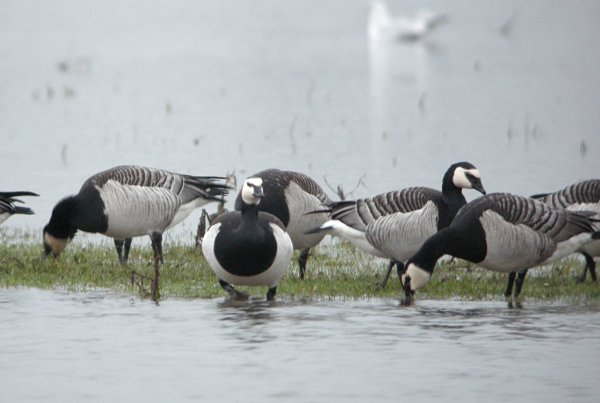
Of particular note in January this year was the large flock of Barnacle Geese which made the floods their home for a few days. Usually Barnacle Geese appear in small numbers in the county as escapee's etc and aren't "tickable" at all but these birds were part of the large feral flocks that live in the home counties and which are classified as official Category C birds and therefore officially tickable. They're at least as tickable as the Greylags that everyone has no problem counting in their county year list so I was rather surprised that more county listers didn't come to see them.

Tickable Barnacle Geese

Last winter was of course a great one for Waxwings and we had quite a few sightings of these lovely birds to start off the year.


A Firecrest that was found by Tom Evans in the Trap Grounds was a great record for the Patch (the first and only one on the Meadow to my knowledge).

Gary the Adult Glauc

In particular the gulling was superb at the start of the year with Caspian Gulls, Iceland Gulls and Glaucous Gulls including a splendid adult bird (a very rare age for this species in the county) which spent several weeks visiting the floods on and off.

By many counts spring was rather disappointing from a wader point of view. Sure we managed to see all the common species that we would normally expect but the floods started fading just at the critical time and there were no Wood Sandpipers this year - normally we might expect several of these rarer waders in the spring on the Meadow. We were blessed with several Avocet in March though which were nice to see.

Avocets (c) Roger Wyatt

We did have a good spring for passage passerines with several Redstarts in Burgess Field (normally a very rare bird on the Patch), plus some Whinchat and even a confiding Tree Pipit.

Burgess Field Tree Pipit

A summer plumaged adult Little Stint at the end of April was a nice bird - this age and plumage is rare in the county.

Adult Spring Little Stint

By the time we were getting to May, the floods were starting to look rather stale and in severe need of a top-up and during this month they basically more or less dried up completely. Still we managed to attract several Garganey; some Whimbrel also popped in albeit briefly.

Garganey are always lovely to see

June was basically flood-free though a couple of probable Spoonbills in the last puddle in early June added some excitement. Steve Goddard managed to turn up an Upper Thames area moth first in the form of the micro Telechrysis tripuncta.

Telechrysis tripuncta

After that it got very quiet for a while with just butterflies and moths to break the tedium of what was largely a birdless desert. I managed to find a rare micro as well with this Metalampa Italica, only the third ever record for the area. July, August and September seemed to drag on for ever with no flood water and no birds.

Metalampa Italica

Finally, in the start of October a birding miracle happened. I was just trudging back from another fruitless search of the still bone dry Meadow when I heard the unmistakable call of a Yellow-browed Warbler. It was a good autumn for this Siberian vagrant nationally and fortunately one chose to linger for a few days at the bottom of Walton Well Road by the car park.
 
The Yellow-browed Warbler (c) Roger Wyatt


After that it was back to birdlessness until the second half of the month when, thanks to some decent rainfall, the flood waters finally returned. These remained until the end of the year and with the water came the returning gulls which kept me happily occupied for the rest of the year. The highlights of the last two months were three Caspian Gulls (two adults and a 1st winter) and a juvenile Iceland Gull.

Caspian Gull

Iceland Gull


So that was the year on the Meadow. The final year list total was 134 with the Yellow-browed Warbler being the only addition in the second half of the year. There's no doubt that this warbler should get the title of "Bird of the Year" on the Meadow - it was a real gem. I feel really privileged to have such a wonderful patch so close to home which I can visit - it really is a joy to bird. Let's hope for an even better 2014.

Monday 30th December

My final visit of the year to the Meadow found it back in full-on Lake Mode after all the recent rain. The waters were about in line with the north end of Burgess Field and there wasn't really any dry strip along the river shore at all. The ducks seemed happy enough out in the middle and there was a good count of PINTAIL (about 20), quite a few Gadwall and a couple of Red-head GOOSANDER to add some variety to the usual species. The gang of four REDSHANK were hanging out by their favourite tree stump opposite the poplars as they usual do when the floods are this large. At least the Meadow is going to start the New Year with plenty of water!

Saturday 21st December

I hadn't realised quite how long it had been since my last posting until I came to do a write-up today. Sadly this has been because there's not been much of particular note to report though I've been dutifully visiting most weekday evenings to check things out. Now that it's the Winter Solstice, winter is officially here though it has been unseasonably mild and rainy of late. At least the rain has has topped the floods up which are now back to a healthy size.

On the bird front the DUNLIN have been a regular feature with five present more or less constantly since my last posting and a RUFF sometimes about as well. The gull roost has been moderate in size with nothing of particular note apart from a few YELLOW-LEGGED GULLS this week. Today Tom Wickens reported a couple of SHELDUCK which are new in.

In the last few weeks I've also had reports of three REDSHANK, a female GOOSANDER coming in to roost and a JACK SNIPE that was lurking along the west shoreline until Matthew Foster disturbed it. Adrian Gray also reports three GOOSANDER up in Wolvercote in the Gullet as well as a couple of Blackcaps in his garden. I too have had a couple of these charming warblers briefly in my garden of late.


Monday 9th December - Iceland Gull!

The Meadow gull purple patch continues! This evening there was a very smart 1w/juvenile ICELAND GULL in the roost. It looks like the same bird that Ian Lewington found yesterday afternoon at Didcot though Roger Wyatt found a second bird today, again at Didcot. There was also an adult YELLOW-LEGGED GULL - the first that we've had for a little while now.


The Iceland Gull was a real cutie!


Some video footage

On the wader front there were a couple of hundred Golden Plover though some over-zealous photographers managed to flush most of them. I did notice a rather interesting very pale, plain bird in amongst them though structurally it was identical to the other birds and so it certainly no more than an aberrant European Golden Plover. There were also four DUNLIN knocking about tonight.

The aberrant Golden Plover

Friday 6th December - Caspian Gull

I'd not been able to get to the Meadow the two previous evenings so I was keen to see what might have changed since my last visit. The answer was not a lot though there were now 6 or so DUNLIN and Mary Gregory reported a couple of REDSHANK and a LITTLE EGRET about earlier before one of several rampant dogs chased them off. The gull roost was once again a relatively modest affair though a smart first winter CASPIAN GULL was nice to see. That's now the third Caspian in eight days that we've had - a real purple patch! It's interesting though that Yellow-legged Gulls have dropped right off - I've not seen one for a while now.

A grab of the 1w Caspian Gull...


... and some video footage of the same bird

Another interesting gull in the roost was a large first winter bird with rather pale frosted primaries. Ian Lewington reckons that it's probably just a rather pale argentatus though there is also the possibility of a Viking (Glaucous x Herring hybrid) back cross.


The Herring Gull with a possible Glaucous influence in there somewhere

Tuesday 3rd December - Mediterranean Gull

The gull roost was disappointingly small this evening with remarkably few large gulls and no sign of the Caspian from yesterday. There were quite a few Black-headed Gulls about with a nice first winter MEDITERRANEAN GULL in amongst them. Apart from that there were four DUNLIN, a REDSHANK (reported by Mark Ribbon) and a smattering of Golden Plover. The floods are starting to recede a little now as it's been a few weeks since the last serious rainfall. A little top-up wouldn't go amiss.

This evening's Med Gull

Monday 2nd December - Caspian Gull

It's still rather quiet on the Meadow. Over the weekend there was a RUFF on Sunday and the DUNLIN count has gone up to six birds today but it's generally the same birds doing the same thing. Of late the only variation comes in the lucky dip that is the evening gull roost. Today came up trumps when in amongst a rather small gathering was a beautiful adult CASPIAN GULL. Unlike the slightly dodgy eastern one last week this one really looked the part and because of the small numbers in the roost I was able to enjoy wonderful unobscured views of this handsome gull.


What a cracker!

The light was just about good enough for an actual photo rather than a grab. 
Fortunately it was standing rather still as the shutter speed was only 1/20 sec.

Thursday 28th November - Caspian Gull

As you will have noticed, I've not posted anything for several days. It's not been for want of trying but there hasn't been that much to report with basically slight variations of the same birds all week. The highlight on the wader front was a second RUFF which appeared on Monday though by Wednesday we were back down to a single bird again and this evening it too had gone. By way of compensation though the DUNLIN count has gone up to five birds. The Golden Plover seemed to be around less, though I don't know whether it's because they've been disturbed prior to my last-light visits or perhaps they've just found somewhere else for now. Duck numbers continue to be solid though the Pintail seem to have moved on. Even the gulling has been somewhat disappointing up until today with rather small numbers in the roost. I presume that this is because of the relatively settled weather which has meant that the gulls could linger for longer in the fields or tips during the day before going off to roost. There have been a few YELLOW-LEGGED GULLS each evening but little else of note.

Tonight finally I did find a noteworthy bird in the roost in the form of an adult CASPIAN GULL. It certainly wasn't a classic "Pontic" (western) bird and had a lot of black in the primaries but according to Ian Lewington it more or less falls within the acceptable range for the darker winged eastern European birds. As Ian points out, there's a lot of interbreeding in amongst eastern birds with crosses between Caspians, Yellow-legged, Herring and even Lesser Black-backed and these hybrids often then going on to breed themselves. So, not a classic bird and perhaps there's a bit of a hybrid in there somewhere but it's nice to have such an interesting bird in the roost.


Some video of the bird preening, revealing the primary underwing pattern

...and a grab

Sunday 24th November

Family commitments meant that I wasn't able to visit the gull roost on either day over the weekend but I did manage a Sunday morning walk around the Patch. At the Trap Grounds I met up with Mary Gregory who was explaining about all the work that is going on there to turn the place into a better habitat. It all sounds very interesting and I look forward to seeing how it will all turn out. One noticeable improvements already from this year has been the addition of the wild Thyme and Marjoram in the open area which was an absolute magnet for the butterflies and bees this summer.

Burgess Field, which I haven't visited in a long while, was as birdless as ever though there was a nice flock of about 30 Redwings in the north east corner. On the floods themselves it was a case of the usual suspects in the usual places though today there was more of interest on the wader front with the discovery of one REDSHANK, the 3 DUNLIN still and a now RUFF as well hanging out near the Golden Plover flock (the latter now numbering about a thousand). The floods are looking pretty good now so with any luck they might all stay a while and might even attract some more waders in. Other birds of note this morning were a single drake PINTAIL and an adult YELLOW-LEGGED GULL amongst the loafers.

The cheery Wigeon, often overlooked but they are lovely birds with a 
wonderful "surprised" call.

Friday 22nd November

I've been laid up with a nasty cold for the last few days so haven't had a chance to visit the Meadow. Today I felt a bit better and so braved the cold weather in the company of Liam Langley to see what was about. The answer was pretty much the same birds as usual. The Golden Plover flock is currently half the size that it was at its recent peak, numbering about 750 birds and today there were 3 DUNLIN keeping them company. The usual ducks are there in their usual numbers with two pairs of PINTAIL being noteworthy. The gull roost was reasonable this evening with a very high percentage of large gulls - I don't know where all the Black-headed Gulls had gone. There were at least 8 YELLOW-LEGGED GULLS in amongst them, mostly adults though with several third winters as well.

This rather petite Yellow-legged Gull is probably a female

Sunday 17th November

It's been a rather quiet few days. I've been diligently checking out the Meadow each evening though it's basically been the same birds in the same numbers since my last posting. Each evening there have been a few YELLOW-LEGGED GULLS in the roost and I'm pleased to report that large gull numbers are continuing to increase and that we're now basically up to full strength in terms of numbers. The Golden Plover flock still numbers well in excess of one thousand birds and a very impressive sight they make when they all take to the air at once.

Tonight there was finally a little bit of variety when Andy Last paid a visit to the site. He managed to turn up a smart adult MEDITERRANEAN GULL in amongst the Black-headed Gulls though unfortunately a couple of people chose to take a walk right along the west shoreline and managed to put up all the gulls so it had gone by the time I'd arrived. Andy also reported four PINTAIL (two drakes) and an adult YELLOW-LEGGED GULL and there were a couple of REDSHANK knocking about as well.

The adult Mediterranean Gull (c) Andy Last

Wednesday 13th November

I wasn't able to get out for "last orders" on the Meadow so instead I opted for a post lunch visit. I must admit it was a pleasant change viewing the birds in bright sunshine as opposed to the usual twilight gloom. It was pretty much the usual fare: there were only 2 DUNLIN instead of the impressive 25 from Monday, the Golden Plover flock is still somewhere between 1 and 2 thousand birds, sadly still with no American interlopers, there are good numbers of the usual duck about and a sprinkling of Lapwings. All in all a very pleasant winter birding scene though with nothing rare to add that extra frisson.

Liam Langley managed to add an adult YELLOW-LEGGED GULL and 3 PINTAIL to the tally in an evening visit.


Walking back along the Castle Mill Stream I came across this heron. I didn't think that I'd be able to get very close before he flew ...

...but in the end he allowed me to get within five yards without flying off.

Monday 11th November

The Meadow really is getting into its stride now and is in fact now on top winter birding form. The continuing rain has increased the floods still further and it is now heaving with birds again. The Golden Plover flock is at least 1500 strong and today there were about 25 DUNLIN in amongst them - a very large count by Oxon standards. Duck numbers are very good with now about a dozen Shoveler as well several hundred Wigeon and Teal. The gull roosts are now finally pulling in reasonable numbers of large gulls. On Saturday there were three YELLOW-LEGGED GULLS though some walkers managed to put up the entire flock rather early on.


This evening, this gull caught my eye though as you can see from the above grab it was nearly completely dark by the time I found it so videoing it was not much use. I decided to try a still photo instead and with the ISO cranked up to 3200 and the exposure up 3 notches I managed to get the following shot with a shutter speed of 0.8 secs!!! Fortunately the bird was standing very still.


I'm amazed at how well it turned out. You can even see the large white mirror and the small white tip on the P10 primary underside that marks this out as an adult Yellow-legged Gull.

There are a few Caspian Gulls now knocking about the county with an adult roosting at Farmoor tonight so one could easily turn up on the Meadow. Finger's crossed!

Thursday 8th November

Much more settled weather this afternoon on the Meadow. There was a bit of interest on the wader front in the form of a REDSHANK along the North Channel - the first I've seen this autumn though Steve Lavington reported one last weekend. The Golden Plover were absent apart from a flock of about 100 circling high over head though a passing dog walker did report that the huge flock from yesterday was still about first thing this morning. The gull roost was still relatively modest, at least as far as large gulls was concerned though once again there was an adult YELLOW-LEGGED GULL in amongst them. There was also an interesting Herring Gull which had pure white primaries, at least on one side; on the other side the outer ones were white but the inner ones were black. Liam Langley also reported fly-over a TUFTED DUCK - not such a  common bird for the Patch.

Aberrant Herring Gull:  Left primaries are pure white...

 ...whereas the inner two are black on the right side


Wednesday 6th November

It was gloomy and rather breezy for my late afternoon visit to the Meadow today. When the weather is poor I always like to wonder whether some rarity has been grounded there just waiting for me to find it - though as usual I was disappointed in that respect. Whilst there was nothing rare at least the Meadow was incredibly "birdy" today. There were at least 1500 Golden Plover and it was quite a task sifting through them all especially given how poor the light was. Duck numbers were sharply up again as well with at least 500 Wigeon and a good number of Teal as well. Even the Shoveler count had gone up to about a dozen birds now. The only disappointment was the gull roost which was surprisingly moderate given the conditions though I did at least manage to find one smart adult YELLOW-LEGGED GULL, a different individual from last night's bird. The tertial white-tipped 1w Lesser Black-backed gull was back for the third night as well.

Tuesday 5th November

The Meadow is taking on more of its winter mantle as each day progresses. Thanks to the continuing rainy weather the floods are increasing in size though they are still some way off their ideal size. The usual birds are about in increasing numbers and finally we're starting to get a proper gull roost again. There have even been some waders to report over the last week with Steve Lavington finding a REDSHANK over the weekend and today there was a single winter-plumage DUNLIN in amongst the Golden Plover, the latter numbering about 500 birds today. There now are several hundred Wigeon and Teal as well as a decent smattering of Shoveler.

Today in the gull roost I managed to find about 120 large gulls, mostly Lesser Black-backed though with a few Herring Gulls and the first YELLOW-LEGGED GULL of the season in the form of a distinctive adult with a deformed upper bill.

You can't really tell from this rather poor grab of the Yellow-legged Gull 
but the upper bill is overly long giving it a sort of hooked appearance

This distinctive 1w Lesser Black-backed Gull with unusual thick white tips to the tertials has been present for the last couple of nights in the roost. The length of its primary projection lead me to wonder whether it might be a candidate "Baltic Gull" (l. f. fuscus) but according to Ian Lewington they're almost impossible to ID in the field at this age unless they happen to be ringed.

I heard the Medley Farm NUTHATCH piping away this week as well - it's nice to know that it's still around.